NASA Maps a New Way to Find Planets With Gravitational Waves
A future space observatory could reveal planets around paired dead stars — a planetary population astronomers have not yet confirmed.
By shahzad
7 min read1 readers
In this story
Key takeaways
Two studies published November 10, 2026, outline how the future LISA observatory could detect planets by reading changes in gravitational-wave signals from pairs of white dwarfs.
The method could reveal planets around binary white dwarfs, a population in which no exoplanets have yet been confirmed.
This is a detection plan, not a discovery announcement: LISA is still in development and is expected to launch in the mid-2030s.
NASA announced on November 10, 2026, that two new studies describe how the Laser Interferometer Space Antenna (LISA) could find exoplanets by measuring tiny changes in gravitational waves from tightly orbiting stellar remnants. The research could open a route to finding planets that conventional telescope surveys may miss, but no planet has been detected with this method yet.
What did NASA's new gravitational-wave studies show?
The work centers on binary white dwarfs: pairs of dense, Earth-sized remnants left behind when stars like the Sun exhaust their fuel. When two white dwarfs orbit closely, they produce gravitational waves — ripples in space-time that carry information about the motion of massive objects.
A planet orbiting the pair would tug on the two stars as it moves. That motion would slightly alter the gravitational-wave signal, creating a pattern researchers could look for. The technique is analogous to the radial-velocity method already used in astronomy, which detects planets through the small wobble they cause in their host stars.
The first paper, “Receiving Exoplanet Messages with Gravitational-wave Carriers”, was published in The Astrophysical Journal on November 10. It develops the gravitational-wave radial-velocity method and examines which planet masses and orbital periods are most favorable for detection.
The second paper, “Multimessenger Exoplanets”, explores how astronomers could independently confirm a candidate using infrared observations from NASA’s James Webb Space Telescope (JWST) and astrometry — precise measurements of a star system’s position and motion.
NASA’s November 10 research explanation says no planets have yet been found around binary white dwarfs. That makes the proposed target population especially interesting: a successful survey would add a type of planetary system not represented in the confirmed exoplanet catalog.
Why could this change the search for exoplanets?
Analysis: Astronomers usually find exoplanets by observing light: a planet can dim its star as it passes in front, or make the star appear to wobble. Those methods work well, but they do not provide an equally clear view of every kind of system.
Gravitational waves offer another way to study the universe. They are not blocked by dust in the same way as light, and their signal can reveal the motion of compact objects that are difficult to study with ordinary telescopes.
NASA says astronomers estimate the Milky Way contains about 10 million double-white-dwarf systems with orbital periods shorter than an hour. Those systems could produce gravitational waves in the frequency range LISA is designed to observe. Researchers expect the observatory to resolve roughly 10,000 individual systems.
That estimate is not a prediction that LISA will find 10,000 planets. It is an estimate of the number of individual binary systems the mission may be able to distinguish. Only some may host planets, and only some of those planets may produce signals strong enough to identify.
The potential payoff is a wider census of planetary systems. If the method works, researchers could investigate planets orbiting stellar remnants rather than only planets around ordinary, active stars.
How would LISA and the James Webb telescope work together?
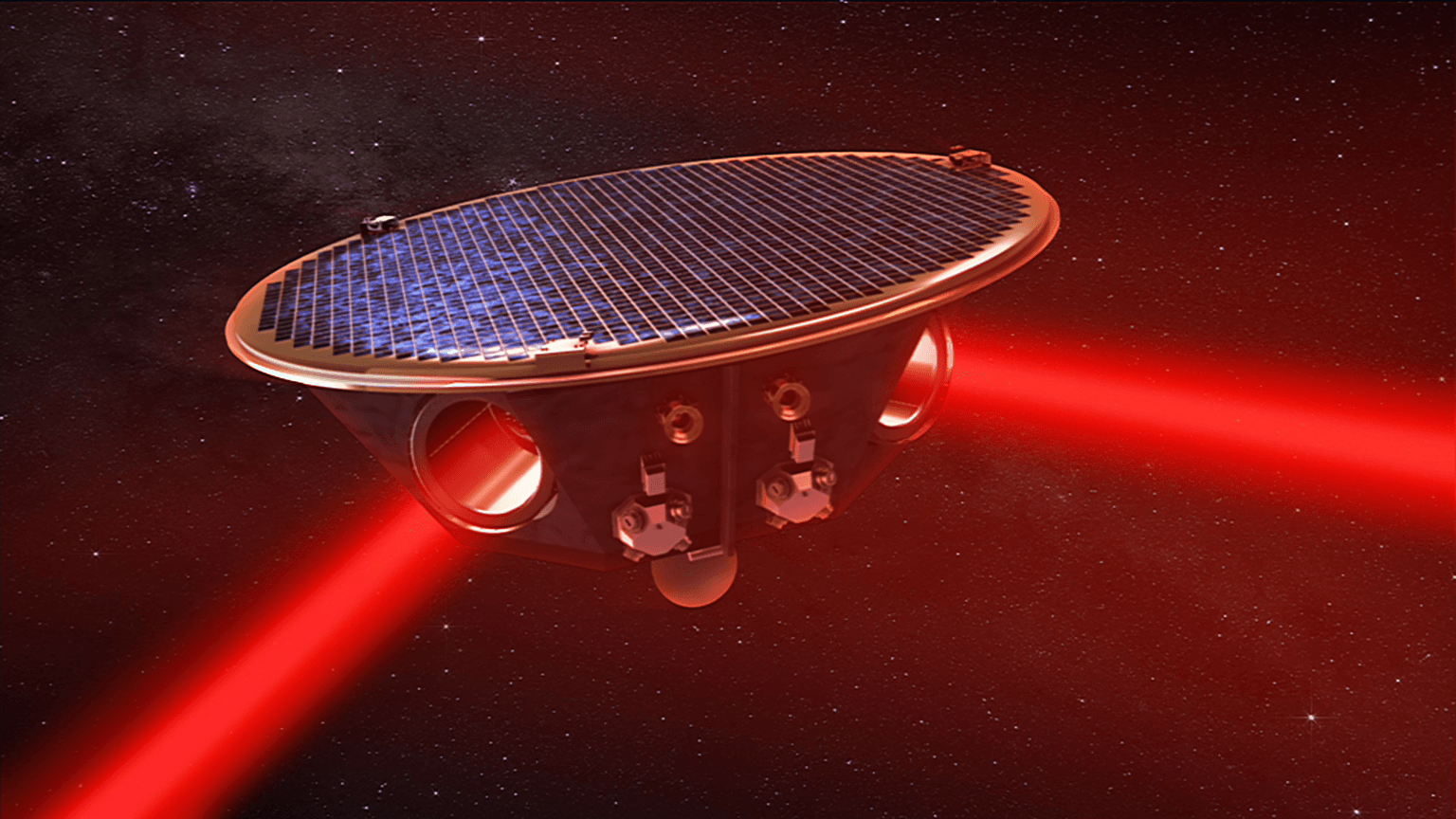
LISA is a space observatory being developed under the leadership of the European Space Agency, with NASA as a partner. Its three spacecraft will fly in a triangular formation, with each side spanning about 1.6 million miles (2.5 million kilometers). Lasers will measure minute changes in the distances between spacecraft as gravitational waves pass through the formation.
NASA currently expects the mission to launch in the mid-2030s. That means the new studies describe a future capability, not an instrument that can begin searching for these planets immediately.
The researchers also outline a way to check possible detections. A planet around a double-white-dwarf pair could add infrared light to the system. JWST could look for that extra infrared signal, helping determine whether a gravitational-wave candidate is a real planet rather than a false positive.
For a modeled system 500 light-years away, the team found that JWST could detect a planet about five times the mass of Jupiter. Under ideal circumstances, LISA could detect a planet smaller than Jupiter in the same example. These are model-based sensitivity estimates, not confirmed observations or guarantees for every system.
The two observatories would therefore play different roles: LISA could identify candidates through gravitational waves, while JWST could provide an independent infrared check for some of the nearer systems.
What should space watchers take from the announcement?
There is no action required for the public, and there is no new planet to add to a stargazing list yet. The practical takeaway is that astronomers are developing another way to search for worlds that might otherwise remain difficult to detect.
Readers following NASA’s wider space program can also see Big Zero’s coverage of the ESCAPADE spacecraft’s journey toward Mars and the NASA student Moon-base challenge. Those projects have different goals, but they show how space research spans missions, instruments and future exploration.
For this LISA research, the milestones to watch are the mission’s development and launch schedule, the eventual quality of its gravitational-wave measurements, and whether the first candidate signals can be checked with independent observations.
What remains unknown?
The studies do not establish how many planets LISA will find, or whether the first candidates will be easy to confirm. The result will depend on the actual systems LISA observes, the strength of their signals, and the ability of follow-up instruments to separate a planet’s effect from other sources of variation.
The launch is still years away. NASA describes it as a mid-2030s mission, so the new research is best understood as preparation for a future survey rather than a near-term discovery forecast.
There is also an important distinction between a possible signal and a confirmed planet. The researchers explicitly identify independent follow-up as important, particularly because false positives could otherwise be mistaken for exoplanets.
FAQ: What readers should know
Has LISA discovered a new planet?
No. The November 10, 2026, announcement describes a method that a future observatory could use. No planet has yet been confirmed around a binary white dwarf using this approach.
What are gravitational waves?
Gravitational waves are tiny ripples in space-time produced by accelerating massive objects, such as two compact stars orbiting each other. Scientists detect them by measuring extremely small changes in distance.
When will the LISA mission launch?
NASA says LISA is slated for launch in the mid-2030s. The mission is led by the European Space Agency, with NASA contributing hardware, engineering and scientific support.
Why is the James Webb Space Telescope involved?
JWST can look for extra infrared light that a planet may add to a double-white-dwarf system. That observation could independently confirm some candidates identified through gravitational waves.
Could LISA find planets smaller than Jupiter?
The study says it could detect a sub-Jupiter planet under ideal circumstances in a modeled system. That does not mean every planet below Jupiter’s mass will be detectable.
Bottom line
NASA’s new research gives astronomers a detailed plan for using gravitational waves to search for planets around pairs of white dwarfs — systems that have not yet yielded a confirmed exoplanet. The next major step is the development and eventual launch of LISA; until then, these results are a promising method, not a planet discovery.